Showing posts with label Plant profiles. Show all posts

Friday, August 7, 2009

Hollyhocks in the Cottage Garden


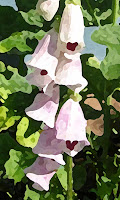
There's not many flowers that represent the Cottage garden look to me more than Hollyhocks. They are a personal favorite of mine, because my Mother and Grandmother both grew them.


I love the color on this one....the closest to red I've seen on a Hollyhock.


I don't remember planting it in this spot, so it must be a volunteer. Volunteers are always welcomed in my garden. :-)


Echinacea 'Magnus' (which I did plant) is in the foreground of the Hollyhock, and makes for a pleasing combination, with it's reddish central cones echoing the red tones of the Hollyhock.


A wider view of this particular grouping of flowers includes pink Mallow, a white Hollyhock, and some volunteer Black Eyed Susans. Don't you just love how unplanned combinations can sometimes turn out to be the prettiest?


Wednesday, August 20, 2008

Helenium Mardi Gras


This was my first year to order a few plants from Bluestone Perennials, and Helenium Mardi Gras was among them. Helenium also goes by the name Helen's flower, or Sneezeweed.


The flower petals are mainly yellow, splashed randomly with red. They have a sort of tie dyed look, which.... for some reason, I seem to be attracted to. (See this previous post.) The brown center cone on some of the flowers appears as though it is wearing a delicate crown around the outside edge....as seen in the bottom flower in the above photo.


This second photo shows some of the tightly packed flower buds, which are attractive in their own right. I look forward to this plant growing into it's full height and stature in the next couple of years. It it quite winsome, and has definitely secured a place in my perennial garden.

~~~~~~~~~~~~~~~~~~~~~~~~~~~~~~~~~~~~~~~~~

Since Helenium also goes by the name Helen's Flower, I am dedicating this post to Helen...
my sweet sister-in-law. :-)


Tuesday, May 6, 2008

Arrowleaf Balsamroot

I've been doing a series of posts this Spring on the wildflowers that grow in our area. As the weeks progress, many different wildflowers come and go. The month of May is when the Balsamroot comes into bloom and thickly covers and beautifies the mountains here.


Arrowleaf Balsamroot is a sturdy, 1-2 ft. tall plant with large 4-5 in. bright yellow sunflower-like blooms. The arrow shaped, silver gray leaves are covered with fine short hairs. It grows in clumps and is a long-lived, drought tolerant native perennial that goes dormant in summer until the following spring. The above photo was taken just a short hike from our house.


This is my favorite Balsamroot photo. This clump was growing up and through another wild plant with ferny foliage, which I haven't yet identified.


Here you can see the silvery gray-green stems and arrow shaped leaves. The entire plant is edible to humans. Native Americans would peel and eat raw the tender inner portion of the young immature flower stems. They also ate the large roots and seeds. The roots are tough and woody and taste like balsam. To make them more palatable, the Indians would bake them several days in a fire pit. Medicinally, the Indians used the large coarse Balsamroot leaves as a poultice for burns. The roots were boiled and the solution was applied as a poultice for wounds, cuts, and bruises. Indians also drank a tea from the roots for tuberculosis and whooping cough.


A close up of the sunny yellow flower. It is a member of the Asteraceae or Aster family, which includes the Sunflower.


~~~~~~~~~~~~~~~~~~~~~~~~~~~~~~~~~~~~~~~


We gathered the wild-flowers. Yes, life there seem'd one pure delight.....as thro' the field we rov'd. Yes, life there seem'd one pure delight."

George Linley ~ 19th century
Thursday, November 15, 2007

Calendula 'Pink Surprise'


I have chosen a special Calendula as the subject for this week's 'Keepers' post. I grow several varieties, but a favorite for the past few years has been 'Pink Surprise.'


Of course, it is not really a true pink, but more of what I would describe as a blushed apricot. The center petals usually show more yellow, which makes for a very nice, soft effect. There can be quite a variation of tones from plant to plant, which adds an interesting element of surprise.


Calendula's are like sunshine in the garden! They bloom both early and late, and are prolific self-sowers. I bought one packet of 'Pink Surprise' seed 3 years ago and have been rewarded ever since with more seed than I could ever use! It has been one of my hottest items for seed trading on the Garden Web Seed Exchange forum.


A couple of twin blooms, wearing a bit of morning dew!
(Click to enlarge)


~~~~~~~~~~~~~~~~~~~~~~~~~~~~~~~~~~~~~~~~~~~~~~~~


"Flowers always make people better, happier, and more helpful; they are sunshine, food, and medicine to the soul." ~Luther Burbank


Thursday, November 8, 2007

Petunia 'Dolce Flambe'

Although the frost has finished off most of the annuals, there are a few more noteworthy ones I wanted to mention in my series on the 'Keepers' in my garden. These include those I've enjoyed for many years and those more recently discovered, that I will likely grow again because of their individual merits. Today's post is dedicated to a new favorite petunia....'Dolce Flambe'.


This new variety, by an Italian breeder, is so lovely in it's subtle blending of colors...a pale rose infused with lemon and splashed with white. One catalog described the overall effect as "that of a ripe peach." I started these from seed, as I do most of my flowers.


I noticed that the blooms start out a darker rose (such as the ones on the right in the above photo) and then fade to a softer color. This difference also added to the overall color interest of the plant. The light, creamy yellow companion flower here is 'Dolce Limoncello,' by the same breeder. Though I liked the combination, I think 'Dolce Flambe' would look good on it's own, as well.


Though most blooms had just a white edging, some looked like the flowers pictured above. Cool, aren't they? The blooms are about 3 inches across and the plant height is 8-10 inches tall, blooming from early to late summer. Overall, a winner in my book..... I will definitely grow these again for their interesting and lovely shades of pastel color!


~~~~~~~~~~~~~~~~~~~~~~~~~~~~~~~~~~~~~~~~~~~~~~~


Monday, October 15, 2007

Nasturtium - 'Vesuvius'

I am currently doing a series of posts on flowers that I consider "Keepers" in my garden. Nasturtiums are one of my favorite annuals for growing in containers. This was my first year to grow this beauty, named 'Vesuvius".


The lovely salmon-pink flowers are surrounded by dark blue-green foliage that complements the flowers to perfection. (The varigated foliage you see to the right is another potted nasturtium, Alaska.) Vesuvius is an heirloom selection, included in Burpee's 1923 catalog. It grows to a height of about 12 inches.

Each year I like try new nasturtiums....but this will definitely be one that I grow again, for it's lovely combination of flower and foliage!


Tuesday, October 9, 2007

Gentian Blue Larkspur

Among the new flowers I grew this year,
Gentian Blue Larkspur, Delphinium chinensis is definitely a "Keeper!"


I have long been a fan of Larkspur, but this one has the most wonderful blue color! The flowers may be a bit larger than regular Larkspur, and more individually spaced, but the overall plant height is shorter....only to about 12 inches. Mine were grown from winter-sown seed.


Shown here with low growing orange Cosmos, which turned out to be a nice combination. The flowers look a lighter blue here, due to stronger light. In this photo you can also better see the 'spurs' (which give the flower the second part of it's name) and some flower buds on the right. The foliage is delicate and fern-like. Overall, a beautiful plant, which will have a home in my garden next year.... and beyond!

Saturday, September 29, 2007

Queeny Purple Hollyhocks


Over the next few weeks, I hope to do several posts on some of the flowers I consider to be "Keepers" in my garden.... some new to me this year that I liked well enough to grow again, as well as some favorites I have grown for years.


This was my first year to grow Hollyhock 'Queeny Purple', a dwarf plant growing to only 2 - 3 ft. I planted mine in a large pot, from winter sown seed purchased from Parks. They had a long blooming season, which started well ahead of the regular Hollyhocks. Although I usually prefer the single old fashioned Hollyhocks, I found this one to be quite charming!


'Queeny' stopped blooming in the heat of late summer and set seed, but gave me another flush of blooms, on the same stalks, when the nights began to cool. This photo shows a single fall bloom....it looks a bit more pinky-purple than the earlier blooms. The flowers in the background are 'Apricot Profusion' Zinnias, which I grew around the edges of the same container, with the 3 hollyhock plants in the center. I liked this combination, as the zinnias are still giving me color, now that the Hollyhocks are no longer blooming.


Wednesday, August 8, 2007

Corn Cockle

I've discovered another charming old fashioned cottage garden flower! It is Agrostemma githago, with the common of Corn Cockle. It is a hardy, self-sowing annual, which grows to 3 ft. and blooms in early summer. (These have been done blooming now since our hot weather began in July, but I am just now getting to this post!)


This one is called Purple Queen. I love the look of the inside of the flowers....with their detailed "dotted" lines.


The white form has the fitting name of Ocean Pearl.


This lovely shade of light pink is Contessa Pale Pink.


The butterflies like Corn Cockle, too! Mine were interplanted with tall Cosmos and a bit of ferny foliage from the Cosmos was in front of the lens in this photo.....but I like the sort of ethereal effect that resulted.

~~~~~~~~~~~~~~~~~~~~~~~~~~~~~~~~~~

It was my first year for growing Corn Cockle, but it won't be the last.....another lovely Cottage Garden 'Keeper'!


Tuesday, June 5, 2007

Baby Blue Eyes


These are new for me this year in my favorite category of flowers.....the self-sowing Annuals. I was not disappointed. To the contrary, I am quite delighted with them!


The flowers are aptly named, as they are a wonderful baby blue color with white inner eye and delicate black stamens. They grow to 10-12 inches, so are perfect for edging the flower border or in containers. They bloom for 6-8 weeks in spring to early summer.


These Baby Blue Eyes are planted in an old spatterware dishpan, along with some poached egg flower, also new to me this year. But that will have to be another post. :-)


The sky blue color compliments the other flower colors. These are winter sown plants. I will save the seeds and toss them around my flower beds to multiply them for next year. These are soooo sweet and cottage looking! An early flower in a color that you don't often see in the garden.....a winning combination!


Friday, May 18, 2007

Lovely Lupines

Lupines are the classic spring flower. The only thing that could be improved about them is if they had a longer bloom time!

I love this shade of blue, which has been rather elusive for me. Many times I bought plants labeled 'Gallery Blue' which turned out to be pink instead. I will save seeds from this one!

A luscious baby pink! Notice the one in front just starting to bloom.

Here is the same baby pink a couple of days later, with the flower in front revealing it's color.
I like planting at least two plants together for this effect. They look nice together and if I don't happen to like one of the colors, I can pinch it out and let the other remain. I do this with snapdragons, also.

Bi-color twins, against the morning sun.

Next year I hope to have some new Lupine colors, as I started seeds this spring of variety called 'Russell's Prize Mix'. I am hoping for some yellows and whites, but will have to wait until next spring for the flowers. Check back then for an update!